Prompts: latest from ‘Where to Start Writing’ in Margate

Yesterday’s written prompts from our Where to Start session yesterday in Marine Studios in Margate. A beautiful evening as we came out, with Turner skies:

‘Looking back, in many ways the days of the front line were my halcyon days.’

Time Come, Linton Kewsi Johnson about Railton Road in its ‘front line’ times

‘We set off the week before Christmas. It was freezing in London and our luggage sagged under the weight of our expectations and sketchbooks.’

Zandra Rhodes in Iconic

‘Dear Lonely Hearts, / my name is Nate / my hobbies are weightlifting / and tempting fate.’

Roger McGough in The Collected Poems: 1959-2024

‘Behold my bold provider, he can hunt and he can trap, / He can make a set of hinges from a piece of leather strap’

Pam Ayres, Doggedly Onward: A Life in Poems

When I come out of the bathroom, I hear Mum and Mervyn talking downstairs. At the mention of my name, I pause in the hallway to listen, my hair dripping, a towel wrapped around my waist like an untidy skirt

The Lost Past of Billy McQueen, Neil Alexander

Prompts: what fictional characters do for fun

Whether your New Year’s Resolutions were about writing, or whether (like me) you don’t reckon with them at all, this can be an excellent time for flexing your fictional muscles again after the festivities.

When I was little, my dad used to read to me at bedtime and a big favourite was The Wind in the Willows. Through furry creatures who live by and near a river, the book has huge things to say about our inner spirit and what everybody needs to thrive. One of the most important of course is food, so these characters have gorgeous picnics and ad hoc meals where the main ingredient is their wonderful friendship. Ratty (a water vole) is passionate about boating too. Feel free to use any of the following quotes as a prompt for five or ten minutes of writing, or as long as the spirit takes you:

‘And you really live by the river? [said Mole} What a jolly life!’ ‘By it and with it and on it and in it,’ said the Rat. ‘It’s brother and sister to me, and aunts, and company, and food and drink, and (naturally) washing. It’s my world…’ The Wind in the Willows, Kenneth Grahame

‘They had now entered a beautiful walk by the side of the water, and every step was bringing forward a nobler fall of ground, or a finer reach of the woods to which they were approaching; but it was some time before Elizabeth was sensible of any of it.’ Pride and Prejudice, Jane Austen

‘The minuet set Jack’s head wagging with its insistent beat, but he was wholly unconscious of it; and when he felt his hand stirring on his breeches and threatening to take to the air he thrust it under the crook of his knee.’ Master and Commander, Patrick O’Brian

Most stories are quests within a framework of work or love in one form or another, with techniques to escalate the stakes to a satisfying finish. Hobbies can be a side-issue, something to broaden a character’s appeal, or they can be at the heart of the story. If the second, the trick is to fold them in, from the start, so that the hobby itself rapidly becomes a matter of life & death. The British film Brassed Off is a perfect template. The UK’s coal mining industry was being closed down. Many pits had brass bands to help the miners’ breathing and morale, and the band in the film has been spectacularly successful. Two questions interweave: can the band survive closure of the pit, and can the miners themselves survive without work?

More prompts, from books about pastimes:

‘Every instrument employed was severely commented upon; but when he came to the wind, his indignation was terrible.’ Talks with Bandsmen by Algernon Rose, 1894

‘If you landed on a comet, you’d need to keep an eye on its orbit.’ Am I made of Stardust? Maggie Aderin-Pocock

‘Gardeners are born optimists, always looking forward to the year ahead, convinced that they will achieve much more than in the previous year.’ RHS Gardening through the Year by Ian Spence

Or you could sit down with one of your characters for a character chat and ask (writing down the answers as they flow) about their favourite fun things to do. When do they do them? Where? With whom? What are the contexts (teams, times of year etc.)? Is kit involved? Who organises, hosts, starts it all off? The character?(Why/ why not?) How does the character feel about it all? What do they hope for/ want? How’s it going? Why?

Wherever you are, wherever you’re writing, I wish you the very best in 2025 and beyond, and happy writing!

An agent or publisher is interested – what happens next? #getpublished

Congratulations. An agent or publisher is showing enough interest to want to speak with you.

There is usually a slow process of meeting each other, to see if you will get along. The agent or publisher will shower your story with praise, then probably suggest changes to your script and see how you respond. Sometimes they are slight tweaks and can be fixed in a week or two. Other times, you can be asked to do substantial redrafts that take months. Throughout all this, they are looking to see how you handle the situation.

They want someone who responds quickly and takes advice well. If you let yourself be distracted by other pressures IMG_3442

or decide now is the time to close your laptop and take a gap year, IMG_3443you risk losing their attention.

Agents first

Do not expect a contract at an early stage although it can happen. Agents are more likely to be prompt about contracts than publishers and will send you a standard form of around a single page. In July we looked in detail at what agents do.

If a contract does come your way, keep breathing and think about it. You do not have to accept it straight away. You can ask for thinking time if there’s another agent/publisher you’re hoping to hear from. And it’s a good idea to consult the UK’s Society of Authors or a lawyer about the legal terms. There’s usually little you can renegotiate in standard provisions but it helps to be clear about what they mean.

As soon as the agent is happy with your script and has taken you on, your script goes out to chosen publishers. It came as a shock to me that agents get rejections too but it does happen. Maybe someone just pipped yours to the post or the heat has gone off a particular genre in the space of weeks. I have met an author whose agent was passionate about his thriller and spent five years hawking it around the world, but could not place it. There is a long history of classic novels being rejected many times. Rejection does not mean your agent is incompetent or that your novel is worthless. Stay calm, polite and positive – and keep writing the next thing.

The upside is that, at this level, you know your work will have been carefully read and that your agent will sift and report on feedback. If not, go elsewhere.

A publisher says yes

With undying thanks to your agent, you are sitting in the offices of a real, live, smiling publisher who has your work on the table. (In July, I posted detail about what publishers can do for us and when. My first post is here, and part 2 is here.) The publisher’s editor has put you through yet more rewrites and has satisfied the marketing and money people at the new acquisitions meeting that this deserves a chance. You’ve got a deal!

Congratulate yourself again – very few new writers reach this stage. Most publishers take at most one first-time novelist a year. A publication date is set and the cover’s agreed. You have more work to do now:

  • Your help will be vital with publicity and this starts before publication.
  • Prepare your own website if you have not already. Start blogging about your new book and how you came to write it. Podcasts go down well too.
  • It’s never too early to start your social media spinning.
  • Make friends with your local booksellers. They’re lovely and are usually delighted to meet local authors. Your publisher should provide you with some free publicity copies to hand out.
  • Contact local newspapers and blogs to ask for interviews and reviews.
  • Plan your book launch.
  • And try above all to keep writing the next thing. You’ll need it sooner than you think.

They’re asking you to buy some of your own books?

Your publisher will probably offer you the chance to buy some copies of your book yourself, at discount. The idea is that it encourages you to market it, hence all the ‘meet the author’ signing events. Events are tricky if you’re shy and they steal your writing time but the discount (paying 40% of the full price is not uncommon) means that if you sell at 80%, you are still making more profit, more quickly, than waiting for royalties.

Fame and fortune at last?

Most first novels sell fewer than a thousand copies. That’s why the Booker Prize was invented, to help literary novels reach a wider audience. Publishers and agents hope that by the time they publish your third or fourth, preferably in a series or the same genre, the public will have noticed you and the whole exercise will become financially worth their while. They are gamblers at heart. You may be one of the lucky ones who has a substantial advance from a big publisher who is going to flog your book with a great big publicity budget. I hope so. IMG_E1806Even if you’re not … You have become a strange new creature, a published author. That can lead you to other ways of making money (coaching, talks, radio and television appearances). It means too that people see you differently. Instead of the friend they are used to, the one who spends most of the time alone and gives a slightly dejected shrug when asked how the writing’s going, they see a new, confident you with a book in your hand. That book has your name printed on it and they are being asked to buy copies. After all the years of lonely scribbling, there is no finer sensation than welcoming friends to your book launch and watching them queue, smiling and laughing, for you to sign copies for them.

Congratulations, you’ve made it. It has all been worthwhile.

I wish you the very best of luck and happy writing!

When the writing flow stops – 12 TIPS to keep writing

At our last Churchill Writers session, we started off talking about our perfect writing days, when the muse is our best friend and the writing flows like iced mojito down Papa Hemingway’s throat. Then, of course, chat turned to how we keep our writing going when things are not so good.

We came up with this list – feel free to add your own:

  • Keeping a journal can limber up the writing muscles and clear the mind before you start on your novel. Liz Lochhead has described it as like skimming the murky top off a broth before it’s served. I keep a writing journal too and save it for chats with myself about where my writing is going at the minute, what I want out of it and what’s getting into the way. It gives my inner writer the space she needs to be important again.
  • Congratulate yourself as much on good sessions of wool-gathering and writing exercises as on producing pages. It’s all needed.
  • A trick I learned from journalism is to get a rough draft down, quickly, last thing before sleep if need be, so that you have something to work on next time. Anything is better than nothing.
  • If you aim to write at a regular time each day or week, the writing begins to flow at that appointed time as if it has a special welcome.
  • Targets (1000 words per day, or a chapter a day, for example) work for some people, less so for others.
  • Going for long, leisurely walks alone, without (if you can) any thought of fitness or time, helps many writers. Charles Dickens walked huge distances, often through the night. It’s about letting your story and characters settle in the rhythm of your body while your eyes rest on the world around. Take some way of writing down stray thoughts, even if it means scribbling on the back of your hand. It’s not just about the desk. Beside Robert Graves’ beautiful writing room in Mallorca is this: IMG_1291
  • Writing buddies. Arrange to meet a writing friend in your favourite café for an hour or so. Say hello, and then sit a good distance away from each other for your writing time. When your words are done, it’s time to have a good old natter together. This can be a happy way to have a regular writing slot but it’s important not to let the chat happen first, OK? #learnedthehardway
  • Some days are fallow, don’t let them worry you. Just pick up again next time. In fact, life has tides, highs and lows, and it’s important not to punish yourself or get demoralised if writing is squeezed out by a crisis. Come back to it when you can.
  • If you don’t have the chance to write for a while, try writing in short bursts of ten or twenty minutes. Forget about quality, let the writing energy take you wherever it likes. You can do this on the bus, in a café, anywhere, and it will remind you how much you can achieve, and how deep you can go, in just ten minutes.
  • Reading good books and online links about the craft can bring you back into your sense of being a writer after a break away.
  • Remember that, however much you procrastinate, and we all do, once you do give writing your time and attention, the words will come. Every time I used to sit down to write, I would spring off the chair to do something else apparently urgent, maybe about a dozen times. Once I realised that my home was not going to catch fire if I just sat there and wrote, I dubbed it ‘hot chair syndrome’ and recognised that it was part of my run-up to writing. And it went away! I love writing and always feel better if a day has writing in it, and I bet you do too.
  • Keeping work in progress private is, for me, a crucial part of protecting the flow; having to show your workings every day to a well-meaning but critical family member can be death to your progress.

Keep it regular. Keep it to yourself. Keep it fun.

More on Sunday. In the meantime, happy scribbling!

Happy New Year! What’s coming up next?

Happy New Year to you all and thank you for dropping by, so often and in such numbers. As well as happiness for you and your loved ones, I wish you all a productive, successful writing year. If, by next January, you have a regular writing practice and know roughly where your writing is heading, you will have achieved a lot. That may not sound like a lot but, believe me, it is.

Usually with my writing groups, our second term (in a sort of academic year) is about plot. It’s my favourite: we get to sit around telling each other our favourite stories and chatting about books that have stayed with us through a lifetime.

Usually whenever people look for writing advice, they’re after hints on writing dialogue, show and tell, point of view, that sort of thing. The Box of Tricks. Should I change my usual tilt and go for that now? Then, this morning, I read this.

Storytelling is not about cheap tricks and formulaic writing. It is one of our oldest and most valuable crafts. Character interests us readers first. Plot keeps us engrossed until we reach that fantastic combination of inevitability, surprise and bittersweet longing for more that is a perfect ending. It’s not about writing to a tired formula – I am all for you reinventing the wheel as often and thoroughly as you can, go for it! But if your story has hit buffers and you’re not sure why, then thinking about what has worked in the greatest stories of all time can help.

So, the Box of Tricks is going to wait. We’ll start by looking at the oldest classic plot in the book: Quest. See you here on Sunday!

Where are we now?

My blog was later than usual this week so here is an extra post to warm us up for the writing weekend…

We’re travelling deep into the hidden furrows of your characters’ hearts and memories now so it’s time for a breather before we go even deeper. Let’s look around at the places in your story where your characters eat, sleep, work, suffer, celebrate and love.

SHORTCUT

Your draft flows more quickly, more consistently if you get to know those places early in your writing. Most important of all, find out how your characters feel about them.

This is about more than location: what are the colours, smells, textures and sounds that tell us about your character and are significant for your story? What is the atmosphere in each place? How does the air move there? Is it warm or cold, stuffy or clear-headed, does it bring a taste to the mouth? Does it bring memories? Above all, does your character want to be there? Why? If not, where would they rather be and why?

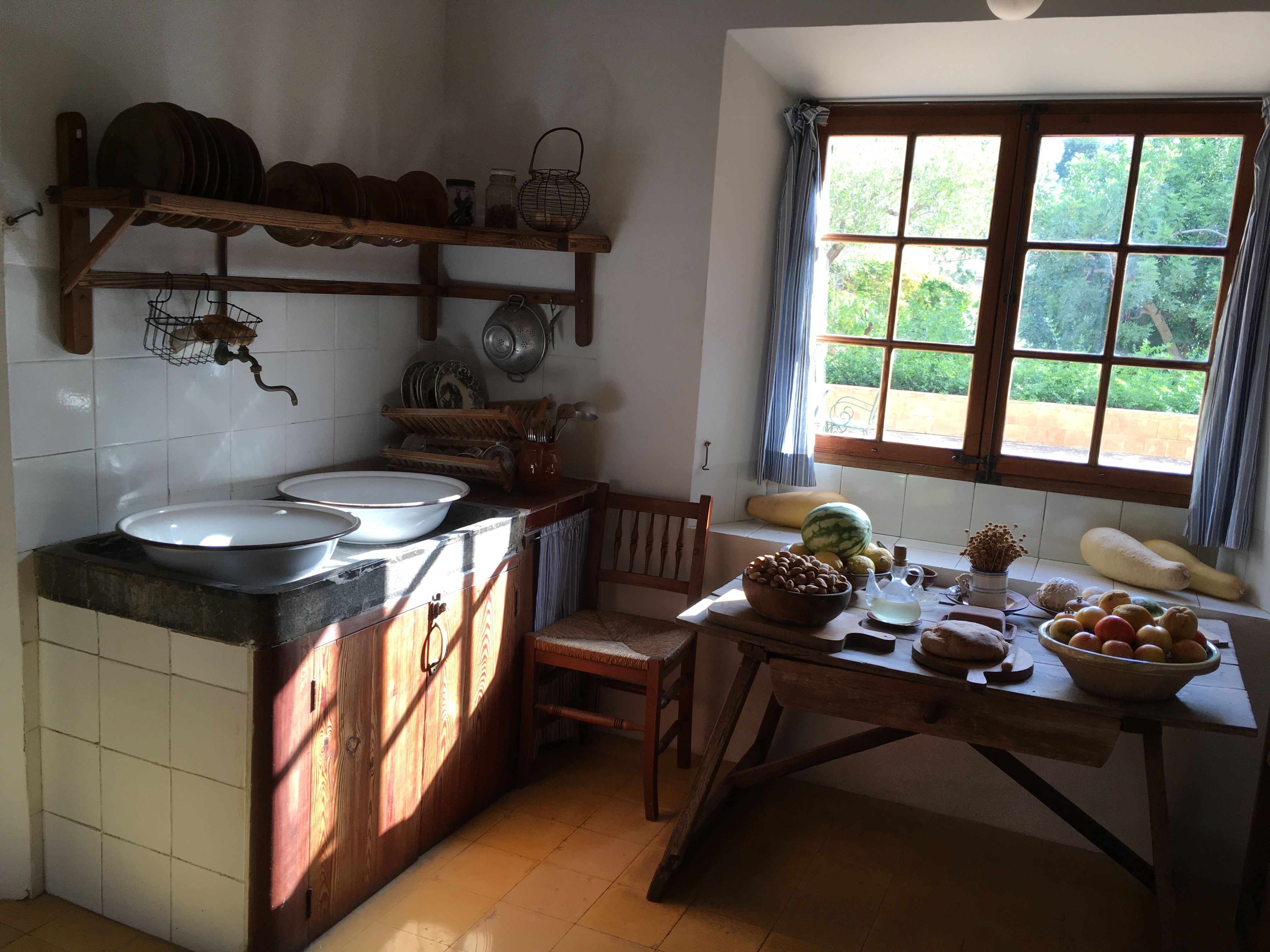
  • Let’s start at home. Using your scribble-chat technique, let your character invite you to where they live and show you, a room at a time, their kitchen, sofa, bathroom, garden/ view from the rooms, bedroom, bed and so on. Robert Graves’ kitchen in Mallorca is below – I loved that place.

IMG_1293

  • How does your character describe their bed. Tracey Emin was right, you’ll learn a lot.
  • Let’s move on to day to day travel – how does your character usually get around? Ask your character to describe their car, bike, route to work etc.
  • From there, it’s easy to lead the scribble-chat to your character’s work place. We spend vast chunks of our lives at work and have a wide range of feelings and reactions to it.

IMG_1186

  • What does your character do in spare time? Find out about their gym, choir room and so on.
  • Can you think of other places that are important to your character? Friends’ and relatives’ homes, for example. Worship spaces. Places to socialise.
  • Where is your character’s favourite place in all the world, real or imaginary?

2016-07-18 20.50.00

Different characters will see the same places differently of course and that’s always fun.

As usual, this is just exploration. You could have another go next week and find yourself up to the eyes in different answers. That’s great! You can choose what excites you most and works best for your characters and your story. Above all, you are immersing yourself more and more in your characters and their world, letting your writing flow, and getting closer to a deeply imagined, consistent draft.

On Sunday we move to Stage 4 – where is your plot’s engine? See you then!