Belfast Lapwing events on 20 September & 4 October – please come!

Once in a blue moon I get the chance to read my poetry in my home city Belfast but very soon I’ll be there twice! We’re celebrating 40 years of wonderful Lapwing Publications and its heart and soul, Dennis and Rene Greig.

Friday 20 September at the Linen Hall Library

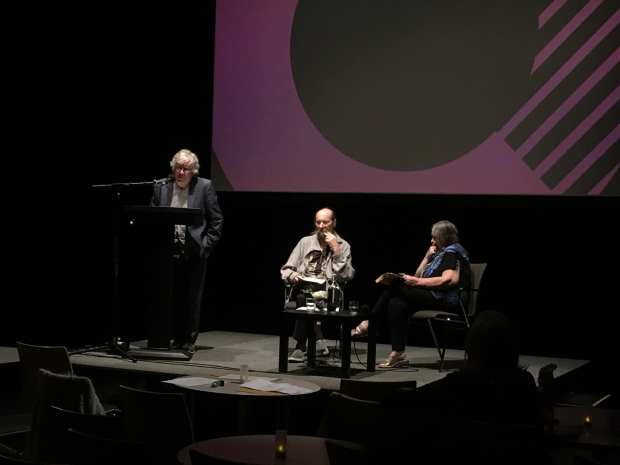
On Friday 20 September – a week tomorrow – between 1 and 2.30pm, poets and friends of Dennis and Rene will read and reminisce at Belfast’s Linen Hall Library. The line-up includes Fred Johnston, Moyra Donaldson, Sam Burnside, Peter Pegnall and myself. Dennis and Rene will be there (all being well) and Damian Smyth will be our master of ceremonies. What a line-up! I’m honoured to be included in what promises to be a unique, amazing event. 

Friday 4 October at the Crescent Arts Centre

Lapwing celebrations continue on Friday 4 October at the Crescent Arts Centre in Belfast from 6pm. Lapwing poets are flying in from all over the place, again to celebrate Dennis and Rene and their marvellous work at Lapwing for 40 years and counting. The line-up so far includes (in no particular order) Alistair Graham, John McGuckian, Shelley Tracey, Fiona Sinclair, Lorna Shaughnessy, Damian Smyth (this time as poet), and again Moyra Donaldson, Peter Pegnall and myself. Eilean Ni Chuilleanain, current Ireland Professor of Poetry is listed too! Another amazing night not to be missed.

Please come if you can to either or both events and say hello.

IMG_3310

Rose Lane Writers – next on Monday 14 October

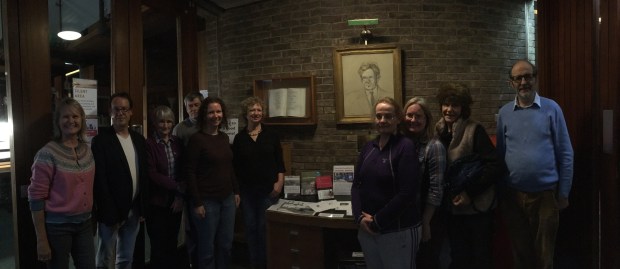
If you’re a writer, the company of other writers is an important, necessary joy and I loved our latest Rose Lane Writers session in Canterbury Waterstones on Monday. What a talented, lovely lot they are.

Our monthly group meets again on Monday 14 October – usual place, usual time. All you need to bring with you is your imagination and whatever writing materials you like best. The sessions are free and everyone is welcome.

Meanwhile, you might enjoy Marina Warner’s BBC radio programmes about storytelling here.

66319026_10158330049602835_5815503662880915456_n


Latest review of Six-Count Jive – in The Lake magazine

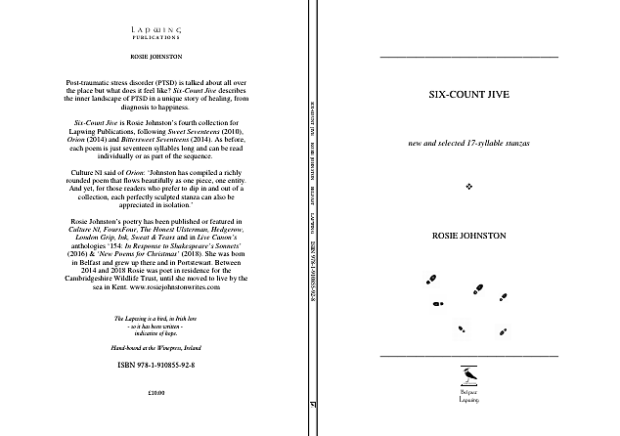
I am unbelievably chuffed to see Fiona Sinclair‘s fulsome review of Six-Count Jive in the latest edition of The Lake magazine. Sinclair’s understanding of mental health issues is razor-sharp and her words have brought me to tears, that my words about PTSD are so understood and appreciated.

It’s been a long haul through ten years of PTSD, and counting, but of course the years that did the damage were worse. Every day is brighter now and I wish everyone with similar struggles the best of physical health (sleep, if you can, gentle walks and healthy eating), loving company and the strength to see each day as a fresh start.

Another happy day. Let’s bless

each second’s

golden gift: survival.

(From Bittersweet Seventeens, Lapwing, 2014)

Sinclair’s review is in full here:

There are many ways of writing about mental trauma. Some writers choose an explicit series of revelations. Yet sometimes this can prove rather overwhelming for both poet and reader. Rosie Johnston has chosen a subtler and indeed I think, a more sophisticated way of dealing with traumatic events and their emotional aftermath. This is largely down to her skill as a poet. In her Six-Count Jive anthology, the narrative arc does indeed move from trauma to recovery.  The poems are comprised of 17 syllable stanzas. They may be small but indeed pack a punch. I feel this self-imposed syllabic discipline is a strategic way of distilling emotions and ensures that events are revealed piecemeal. The result is a sublime exercise in less-is-more, where traumatic events are often inferred. On one level this works as means of self- protection for the writer ensuring that she reveals only as much as she wishes to share with the reader. Moreover, beneath their brevity there is a wealth of meaning.  Johnston in this way gets her readers to mine the verses for details and piece together the wealth of meaning that is subtly layered.  Consequently, the poems bear frequent re-reading.

The poet chooses to use a third person narration. This works well in terms of giving the work distance for the poet and allows the subject matter to become universal. Inevitably there will be recognition for some readers as they move through the anthology. In the first poems the causation of the trauma that drives the work is darkly hinted at, “Spills tears like a glass knocked flat”. The ‘He’ and ‘She’ characters are presented with a lexis of violence that suggests a toxic relationship particularly evoked with the line “That week-old bruise.” Here economy of words and indeed judicious selection of vocabulary is excellently deployed. Yet in lines such as ‘‘She decided out walking to die” horror is presented in an unsentimental way, but its effect is powerful in its understatement. Whilst the narrative implies violence and trauma that leads to a court case, the economy of words shows there is no place for self-pity here but instead great courage in the female protagonist.

This lexis of violence is strategically tempered by more graceful and gentle language “Lie soft, gentle winged creature, roped and dazed;’’ as if the female character is determined to survive this trauma not just physically but also mentally. As the narrative progresses and the female protagonist is physically freed, a struggle begins to address the PTSD that is the lasting mark left by the trauma. Here again Johnston’s skill is to define in a few simple words how,

Trauma throbs its savage

continuo:

wreckage in that small-hours bed.

The poet is adept at using punctuation and within the confines of the 17 syllables it often does the job of words, for example:

Up she flowed-a dove high above

 danger-

watched her own body slumped, splayed.

Here the hyphens suggest the grim events left unsaid that perhaps are too traumatic for the narrator to be fully articulated. Again, the reader is invited to mine for meaning.

Metaphor and simile are used throughout to infer the horror and pain the sufferer of PTSD goes through. They are original and hit the mark each time. One particularly effective metaphor used to describe the isolation of mental illness, that is often self- imposed as a means of self- protection, comes in the simple line. “She lives in a glacier”. This sentence is isolated on the page reinforcing the sense of being separate from the world. Again, the poet is deploying her skill here by using structure to reinforce meaning.

The search for recovered mental health leads to an actual physical movement to the seaside. Initially the lexis reveals the protagonist’s need to feel safe, to lock herself away from the outside world.  This reinforces a need to feel safe. Thus, we have words that suggests a new home that is a “seven- locked keep,’’ Yet as with the rest of the collection there is always a combination of grim phraseology mixed with beauty that suggests a character who despite the horrors of events hints at hope and gives this collection a sense that even at its worst, life can be repaired.

After the move to the sea there is a distinct change in vocabulary as the protagonist ‘‘plaits thick skeins of seclusion and calm’’. Here the uglier phrases are replaced by beautiful imagery of nature and the sea, that reflects the healing within the woman. Although recovery is not linear, and there are of course setbacks, nevertheless we see the protagonist find her way back to better mental health.

The final poem is the antidote to the first. The narrative reveals that although not perfect, with some way to go still, the woman’s mental health is much improved.  For the imagery in this final poem is glorious, and reveals a renewed lust for life where:

Laughter waltzes with garlic prawns,

Jives with olives,

Pirouettes with wine.

Here the language of dancing and music nods to the title of the collection and playfully references a return to enjoying life. The final stanza allows emotions to be set free.  ‘Love.’ previously kept under lock and key is a possibility again, it is:

On the doorstep. Kissing its

own fingers

warm till she lifts the latch.

The stanza is beautifully lyrical with a charming use of personification.

This is a superbly crafted piece of work whose language is at times sublime. The narrative is gripping because it takes us through the protagonist’s process back to happiness. In its deliberate brevity it invites us to mine for layers of meaning and rewards constant re-reading. Its back story and message of survival are life affirming but significantly, this is not an exercise in therapy, instead, Six-Count Jive is a superb piece of art.

Fiona Sinclair

Exciting events on the way

On FRIDAY 20 SEPTEMBER, 2019 from 1 to 2.30pm, poets and friends of Dennis and Rene Greig will read at BELFAST’S LINEN HALL LIBRARY in a celebration of forty years of Lapwing Publications. The line-up includes Fred Johnston, Moyra Donaldson, Sam Burnside, Peter Pegnall and, I’m thrilled to say, me. This is an exceptionally special event for me, not least because of my huge debt to my publisher Dennis Greig and my deep admiration and fondness for him and Rene, but because my darling late father loved the Linen Hall and spent countless happy hours of his life there. 17499381_10155223098717835_5992690378704277205_nHere I am up the Cave Hill in my dad’s rucksack a wee while ago.

On Sunday 20 October, I’m delighted to have been invited – as part of the CANTERBURY FESTIVAL – to read in the Pilgrims’ Hotel, 3pm, with Fiona Sinclair, Derek Sellen, Mary Anne Smith and Luigi Marchini. More details of SKETCHES OF KENT are here!

On Sunday 10 November, 6.30 – 8.30pm, I’m looking forward to being the guest writer at SAVEAS WRITERS in Canterbury at the Pilgrim’s Hotel. I will read from my latest Lapwing collection Six-Count Jive and new poems I’m gathering about the beautiful north Kent coast. This is a free event (donations welcome) and includes an open mic.

On Wednesday 13 November, 2019, 8 – 10pm, I’m honoured to be a featured writer at LONDON LOOSE MUSE ‘s Women Writers Night in the Sun Pub, on the corner of Drury Lane and Betterton Street, in Covent Garden, London WC2B 5RH, just 100 yards from the Poetry Café. This event includes Q & A and an open mic session in each half. Tickets are £6 (£5 concessions).

On Monday 13 January 2020, I am looking forward to returning to read at WINCHESTER LOOSE MUSE: 8pm. Details soon.


Prose, poetry & vinyl at Words on Waves this Thursday

Words on Waves is with MUSIC on Thursday, 5 September 2019, at 6.45pm – POETRY, PROSE & VINYL – and features folk singer Helen North with some of her exquisite, original songs, prize-winning author and poet Maggie Harris, prize-winning poet Mary Anne Smith and Barry Fentiman Hall of Wordsmithery fame.

From September Words on Waves combines music with four booked writers each time (ten minutes each) and open mic sessions for up to ten readers (five minutes each). Fiction, poetry, drama, memoir, published or work in progress – it’s all welcome. We’ll dance, laugh and enjoy words and music together from 6.45pm to 9.30/10pm. Tickets are £5 including wine and soft drinks. See you there!

IMG_5139

Thank you, London Grip, for this wonderful review of Six-Count Jive

Some writers (actors, musicians, artists) say reviews don’t matter. They never bother to look because what’s important is the work and not being deflected from that. But a review is posted today that understands not only my poetry but my life so deeply and sensitively that I am moved to tears.

London Grip has posted Stephen Claughton’s wonderful review of Six-Count Jive here.  Enjoy!

You can find other reviews of my writing here.

Fancy getting hold of a copy to see for yourself? This link will help you.

A couple of thoughts, by the way:

Is each page of Six-Count Jive a single poem? The sequence consists of 93 little stanzas of seventeen syllables each. Mostly they’re grouped three to each page, until the last page where there are four. This was purely by chance. While my publisher Dennis Greig and I were putting the proofs together earlier this year, he started off putting six to a page – in deference to the title, he said, but I suspect he was trying to save paper too. I thought that these intense little pieces needed more space to breathe and managed to persuade him that three on a page would work better. There’s a place in my heart where I would love to see a copy where each 17 has its own page 🙂

Claughton mentions a note in Bittersweet Seventeens. This beautiful, little note, called The Ginger Jar, explains haiku and whether or not my seventeens fit the genre. Some readers have assumed that I wrote it but it was by Dennis, my publisher. At the time, I tried to persuade him to take the credit but he’s too modest and left it anonymous.

IMG_6195 (1)

Happy reading!

Rose Lane Writers start soon at #Canterbury Waterstones

Since 2011, I have been running informal writing groups to share the tricks and skills I’ve picked up through more than twenty-five years of published novels, drama, humour, journalism and poetry. Several of my ‘alums’ have become full-time writers, some are working with agents and publishers, others have successfully self-published and many of them are proud to have finished drafts for the first time in their lives.

Are you longing to write a book and have no idea where to start? Have you stopped and would love to find your way again? Are you well on your way and would just love some writing company and a few tips? You will be welcome to join me in ROSE LANE WRITERS.

Who is welcome?

Everyone.

Cost?

The sessions are free.

Where?

This new group will meet in the café on the first floor of Waterstones in Canterbury, Kent, UK.

When? 

We plan to meet between 10am and noon on the 2nd Monday of each month, starting on Monday 8 July 2019. You needn’t bring anything but your imagination and favourite writing materials. There will be a break at half-time for tea and coffee.

What will we do?

We start with a bit of free-flow writing to get us limbered up. This can be tremendously liberating, no waiting for inspiration, no redrafting, who cares if it’s a bit rough. Like all creativity, writing combines adventure with planning and the quality of what we write in short bursts often surprises us. Something magic happens and our writing takes off in its own intoxicating direction. Come and try with us and you’ll soon know what I mean.

I do all the exercises alongside you, by the way, and sometimes we read aloud what we’ve written, sometimes we don’t. There is no need to read aloud if you don’t want to. Sometimes, even if you have all the confidence and experience in the world, an exercise can bring up something that should stay private. My advice is to write it as honestly and deeply as you can and decide later if you want to reveal it to anyone else. Your privacy is sacrosanct.

We study the craft. Each session has a theme designed to help you avoid pitfalls I’ve learned the hard way. I guide discussions about where to start your writing, how to develop characters, how to find your theme and throughline, whether to self-publish or find an agent – that sort of thing. Coming up to the summer, we concentrate on tricks of the craft like the best uses of point of view and dialogue. Our sessions in the autumn are usually about getting deep into our fictional characters. Spring is one of my favourite times when we look at classic plots and genres.

Our exercises and discussions help writers of non-fiction as well as fiction. It’s all about how best to engage our readers and hook them in with good narrative drive.

Each session has a workshop element too. You are invited to bring about three pages (max, 1500 words please) of your writing to read to the group if you’d like to. It doesn’t have to be the best piece you’ve ever produced – work in progress is fine – and I make sure that feedback is positive, constructive and relevant. I do not permit feeding frenzies of criticism in my groups.

Writing and imagination are like muscles. If they are flexed and enjoyed often, they get stronger and will reward you in more ways than you ever dreamt possible.

If you would like to come, please let me know first – rosiejohnstonwrites@gmail.com or through Facebook. Thank you. 

See you soon!

IMG_2888