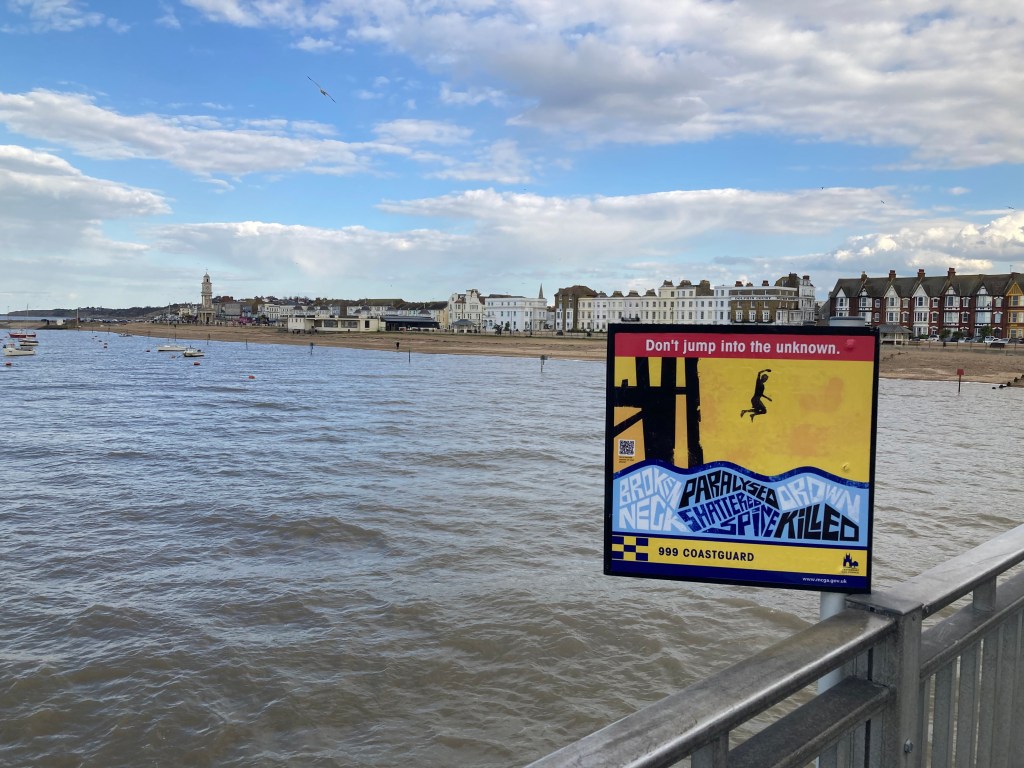
When my first novel was published about twenty years ago (by a mixture of persistence and sheer luck), there were so many things I wish I’d known sooner. Jumping into the unknown can be fun.
But now a potential novel is grabbing me again and I’m up to my eyes in first-draft stuff, all those voices and characters, and I can’t help thinking how many of my worries then were were about things that really didn’t matter until later. So, if you’re writing a first draft too, here are a few of them:
The Perfect Start
Your opening sentence is the last thing you need to think about right now. Write anything and carry on. With a first draft, only one thing matters: at all costs, finish it. Then you have something to work on. There is no point in sweating about your first sentence until then, or even later. If something ideal comes to you, note it down but if nothing comes, don’t worry.
John Mortimer: ‘The only rule … in writing is not to bore yourself.’
Likewise, your title. All you need now is a title that keeps you coming back to your draft. You’re likely to change it later, when you have a fuller idea of what your novel’s really about.
Where to start
When you’re ready to start on those precious draft pages, start somewhere, anywhere and above all, keep going. In Medias Res (in the middle) is time-honoured and great, as Homer taught us. Tidy as you go, then press on. Keep notes of afterthoughts but do not let them hold you back. If you toil endlessly over the same chapter or section, you risk, and it’s a big risk, getting bogged down and demoralised. Ditch notions of perfection for now and enjoy the ride.
Your voice
Another needless dread is about ‘finding your voice’ as if it’s something you left behind on the bus. Your writing voice is nothing more than the way you put words together and it’s special to you alone. It includes all sorts of things like the sort of subject you choose, your personality, the words you think in and your unique way of seeing people. When we hear a turn of phrase on the radio and go ‘Ah yes, that’s Maya Angelou,’ even when you’re not sure which of her books or poems it comes from, that’s you recognising Angelou’s ‘voice’.
Your voice is everything and nothing and is not something you need to think about at this stage. The more you let yourself settle into your happy, low key writing place where you play with your characters and story, the more confident you will be with your words, whereever you are.
Occasionally you might produce something you know could work in your first draft. Off it goes into that first draft file, waiting for other pieces like it. In no time, your pages are building up, some of them spot on, some less so, but the trick is to keep writing. It is by writing plenty that the best can come.
There will be more in my new book, scheduled by Colorful Crow Publishing for publication next year. It’s what I’ve learned over thirty years – usually the hard way − about developing a robust writing process for life, one that acknowledges what is normal in this writing world and offers tricks and tips to keep our spirits up enough to keep writing at every stage through to publication.
Thinking of writing as our treat is a big help. Creativity does people good. For us writers, the simple act of writing, even a few lines of journal, makes the day worthwhile. Happy writing!
I get asked now and again, as if it’s a weird thing to do, why I write. Well, I didn’t always. Lots of us spend years talking and thinking about writing as if that’ll do the real thing for us.
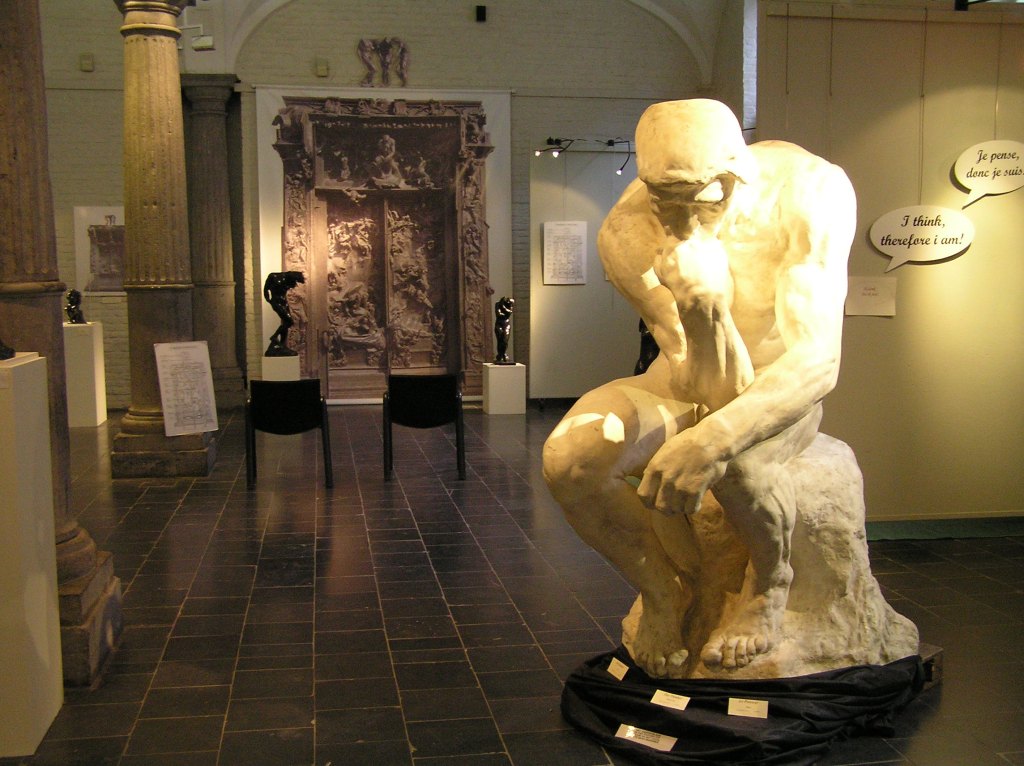
Je pense, donc j’ecris?
I was over 35 before I could muster enough confidence to give time to writing, even though I’d known as a tiny child the great joy of sitting alone in a crowded room, in my own bubble happily making stuff up on a page.
The first answer is that we write for the sheer fun of it. As painters and musicians, sculptors and dancers do, we get a nudge from some inner compulsion, or an unexpectedly lovely experience, that to give ourselves to creativity like this can be pure pleasure. Even more so if we turn out to be good at it though that stage comes much later.
The deeper we allow ourselves to sink into this writing malarkey and give long hours to it, the more fun comes to find us. Thoughts and stories spool from our fingers in ways that don’t feel quite our own and we can’t wait to do it again. If two or more of us are writing together as #writingbuddies, magic can happen in that ringfenced time that releases cascades of imagination apparently from somewhere beyond us.
Then there’s the Rubik’s Cube stage where the pleasure is in fitting words to a poetic structure or wrangling a plausible plot into shape, until the marvellous ‘click’ moment when something might just work.
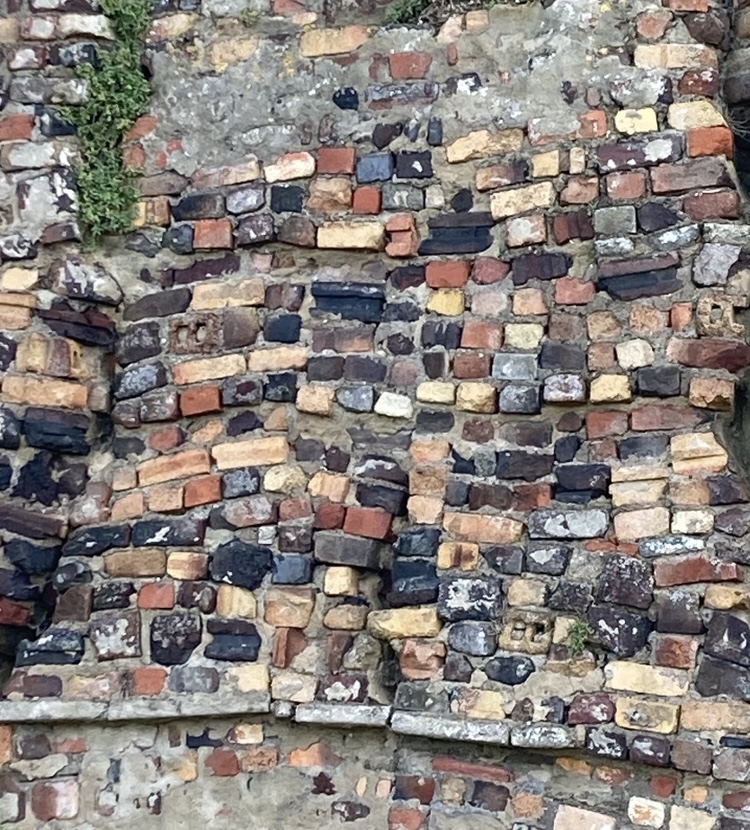
A sea wall close to where I live.
Even editing – condensing, spotting tautology, correcting, trimming – can have a robust thrill like pruning a tired shrub in the allotment before winter.
The wonderful thing about any craft is that the more we do it, the more skilled we get and the more of the craft we want to do. So, here are 3 tips #writingtips to guide you back to your writing if you’ve hit a dry patch. There will be many more in my book scheduled for publication by Colorful Crow Publishing next year:
Try to write something every day connected with your novel or poetry, or just your will to write. Bits of conversation exchanged by your characters, weird rhymes, notes for research, a rant by one of your characters, your feelings about where the plot’s heading in spite of you – writing it down keeps you in the loop of your book or poetry and stokes your inner writer’s fragile confidence.
Always congratulate yourself on writing around your story or poem as much as on producing shiny pages of draft. We all do it. It’s all needed.
If an idea or scene is bugging you and you can’t get started, try this old trick I developed in years of journalism. Get something, anything, down fast, last thing before bedtime. It can be as rough as it comes, it doesn’t matter. When you wake up, you’ll find that two things have happened. One is that you have something to work on. Big step forward. The other is that your unconscious mind has been busy while you slept and you wake to new ideas and verve. You might even have those elusive ingredients: the shape of what you want to write and the all-important gist.
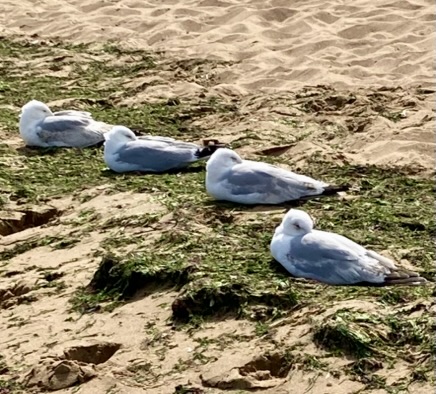
Seagulls working on their gist.
Number 4 is #writingbuddies of course and I’m deeply grateful to all mine, everywhere.
Nolan ignored swathes of excellent, often funny dialogue from the original. My favourites are the deliciously romantic, crossed-purposes-or-are-they conversations between Penelope and Odysseus. Top goddess Athena is utterly dull in Nolan’s film while Homer’s is lithe, funny, flirty, and as wily and quick witted as Odysseus. And Nolan has changed the theme from nostos (the hard toil of an old soldier finding his journey home, joyful at last, to his family, his country and himself) to how dreadful and irredeemable we humans are for destroying the world.
Apart from that?
Ah yes. Nolan has excised possibly the oldest written joke we have. It used to have me and my father rolling around laughing before I was even at primary school. He’d act the dialogue between Polyphemus, the one-eyed giant, and Odysseus who is trying to escape him, with my dad playing all the parts, including the sheep. He was a classicist (Trinity, Dublin in the 1940s) and my earliest bedtime stories were of Paris and the jealous goddesses, Odysseus and Penelope, Hector and Achilles, Agamemnon’s return and the rest.
His whiskey glows by your bedside lamp, ‘Read Trojan Horse again, Daddy.’
Aeneas’s tears at the mural of sorrows, Achilles’ battle rage: he plays them all.
He weaves a lifelong wonderland: Priam, Mozart, the Clancys, Keats.
Colorful Crow Publishing is scheduled to publish my book next year about how to sustain your writing process lifelong. There will be more about Homer’s excellent lessons in storytelling there.
For now though, here are just a handful of Odyssey gems that Sir Christopher decided he could do without. There are plenty more:
Calypso is no therapist. She is another barrier to Odysseus getting to where he needs to be: a ‘love goddess’ who likes sex, has seen the male gods (Zeus in particular) help themselves to that side of life with humans and she’s decided to have her turn. Would those scenes not have challenged Odysseus and engaged us far more than Charlize Theron being all wise and understanding? In spite of Homer describing Odysseus as ‘the most miserable man alive’ in her care, his Calypso won’t let him leave her until the gods command her to set him free. She rants about gender inequality in the divine sphere, then does help Odysseus on his way.
Calypso fed divine ambrosia to Odysseus to cloud his memory . I thought this vivid poppy seed head might be prettier than a bowl of creamed rice.
Zeus’s Law: this is Nolan’s name for the laws of hospitality (Xenia in Greek) that bound and still bind many of us humans, across time and geography. If you have Irish family, you’ll know what I mean. Nolan’s characters forget to mention that guests are as bound by these laws as hosts. Penelope is besieged by ‘Suitors’ who rampage around her home, helping themselves to food, wine and slave girls, knowing that she would be in breach of Xenia if she turfed them out. They’re trying to coerce her into believing that she must be a widow by now, so should remarry one of them, ceding Ithaca, the castle and all Odysseus’s power to her new husband. Those ‘Suitors’ are as much in gross breach of Xenia as Polyphemus, the one-eyed giant, who bites the heads off Greek soldiers who have strayed into his cave.
Every section of Homer’s Odyssey has some breach of Xenia in it, with just two exceptions that I can think of. One is Telemachus’s visit to King Menelaus (lovely behaviour on both sides). The other is Odysseus’s time spent with the Phaeacians who find him washed up on their shore, feed, clothe, listen to him, dry his tears and then help him find the easiest way home.
The Trojan Horse.Nolan has said that his inspiration for the film is the image of a huge bronze horse washed up on a beach. Wherever that came from, it wasn’t from Homer. He’s right that Odysseus’s idea to smuggle Greek soldiers into Troy inside a constructed horse was a severe breach of Xenia. But Homer is clear at every point that it’s a wooden horse, probably knocked up on the battlefield from old bits of carts and boats. Adam Nicolson’s book The Mighty Dead: Why Homer Mattersexplains that at the time of the action of the story, tamed horses had just revolutionised farming and that a horse-shaped gift would have been mightily persuasive. Horses had transformed warfare too, making chariots and javelins new essentials.
How could a bronze horse statue have worked on that battlefield? It would have been improbably difficult to shift. We are told that Trojans shoved swords through to test if anyone was inside. When Helen comes out of Troy to inspect it, Menelaus tells us that she strokes its timbers and whispers, whispers through the horse’s flanks, sometimes in the voices of the Greek soldiers’ wives. How could she have achieved that through bronze?
There are so many clear references in Homer (eg: 4: 272, Menelaus describes Odysseus’s courage inside ‘the Wooden Horse’; 8:493, the Phaeacian king asks the bard to ‘sing to us of the making of the Wooden Horse’ and more) that I can’t help wondering what source Nolan used.
Achilles is a sad loss from the film. I see his super-sized armour still stars, though it’s supposed to be Agamemnon who wears it. No. In Homer it’s Achilles who is part god and of superhuman size and strength, with special armour. It’s a pity to lose the scene, pivotal for Odysseus, when he finds Achilles in Hades (Graeco-Roman home of the dead) and asks how his old friend is doing. Achilles replies that he would give anything to have been the lowest serf or a shepherd quietly on a hillside all his life, rather than the world’s most glorious soldier.
Nolan’s film has Achilles’ armour look like Batman. They do walk among us, these god-like men.
That oldest joke in Western literature that had my father and me giggling all those years ago? Odysseus and his men are trapped in Polyphemus’s cave with his sheep. At dawn, they see that their captor is gigantic but has only one eye, in the middle. How can they smuggle themselves past him and out to freedom? Odysseus works out that if they blind the giant Cyclops and cling to the sides and bellies of his sheep, they can be carried out to safety. They manage, as in the film, to blind the giant and Polyphemus comes out yelling (yes, in the Greek soldiers’ own language): who did this to him? Odysseus says that he did and, when asked his name, quips that his name is ‘Nobody’. When the other Cyclops hear bellowing, that someone’s been hurt, they ask, ‘Who did this to you, Polyphemus?’ The giant has no choice but to reply, ‘Nobody did it. Nobody!’