Treat yourself to some easy writing with prompts from Margate, June 2025

As usual, these prompts are not a task or exercise, just something – a few lines or as a whole – to blend into your thinking, so that when you’re ready to write for ten or fifteen minutes, something will come. Trust that, however long it is since you last had a chance to write, your words are waiting to fall onto your page or screen:

The sun is puce the sky is green

The streets awash with brilliantine

This is my redcurrant dream

(Recurrent? No just the once)

I’m psychedelicate

From John Cooper Clarke’s The Luckiest Guy Alive, 2018

I know a little cupboard,

With a teeny tiny key,

And there’s a jar of Lollipops

          For me, me, me.

From The Cupboard by Walter de la Mare (1873-1956)

This poem is dangerous: it should not be left

Within the reach of children, or even of adults

Who might swallow it whole, with possibly

Undesirable side-effects.

This Poem… by Elma Mitchell

‘This was Mr Strugnell’s room,’ she’ll say,

And look down at the lumpy, single bed.

‘He stayed here up until he went away

And kept his bicycle out in that shed.’

Mr Strugnell by Wendy Cope

The atheist archbishop weeps

Life is just a trap

Gazing into the inky deeps

Of a Chateauneuf-du-Pape

The Ranks of the Heathen Saints from John Cooper Clarke’s The Luckiest Guy Alive, 2018

Who will bring me the secrets of night?

‘I,’ called the Bat. ‘By the moon’s silver light.’

The Treasures by Clare Bevan

When the writing flow stops – 12 TIPS to keep writing

At our last Churchill Writers session, we started off talking about our perfect writing days, when the muse is our best friend and the writing flows like iced mojito down Papa Hemingway’s throat. Then, of course, chat turned to how we keep our writing going when things are not so good.

We came up with this list – feel free to add your own:

  • Keeping a journal can limber up the writing muscles and clear the mind before you start on your novel. Liz Lochhead has described it as like skimming the murky top off a broth before it’s served. I keep a writing journal too and save it for chats with myself about where my writing is going at the minute, what I want out of it and what’s getting into the way. It gives my inner writer the space she needs to be important again.
  • Congratulate yourself as much on good sessions of wool-gathering and writing exercises as on producing pages. It’s all needed.
  • A trick I learned from journalism is to get a rough draft down, quickly, last thing before sleep if need be, so that you have something to work on next time. Anything is better than nothing.
  • If you aim to write at a regular time each day or week, the writing begins to flow at that appointed time as if it has a special welcome.
  • Targets (1000 words per day, or a chapter a day, for example) work for some people, less so for others.
  • Going for long, leisurely walks alone, without (if you can) any thought of fitness or time, helps many writers. Charles Dickens walked huge distances, often through the night. It’s about letting your story and characters settle in the rhythm of your body while your eyes rest on the world around. Take some way of writing down stray thoughts, even if it means scribbling on the back of your hand. It’s not just about the desk. Beside Robert Graves’ beautiful writing room in Mallorca is this: IMG_1291
  • Writing buddies. Arrange to meet a writing friend in your favourite café for an hour or so. Say hello, and then sit a good distance away from each other for your writing time. When your words are done, it’s time to have a good old natter together. This can be a happy way to have a regular writing slot but it’s important not to let the chat happen first, OK? #learnedthehardway
  • Some days are fallow, don’t let them worry you. Just pick up again next time. In fact, life has tides, highs and lows, and it’s important not to punish yourself or get demoralised if writing is squeezed out by a crisis. Come back to it when you can.
  • If you don’t have the chance to write for a while, try writing in short bursts of ten or twenty minutes. Forget about quality, let the writing energy take you wherever it likes. You can do this on the bus, in a café, anywhere, and it will remind you how much you can achieve, and how deep you can go, in just ten minutes.
  • Reading good books and online links about the craft can bring you back into your sense of being a writer after a break away.
  • Remember that, however much you procrastinate, and we all do, once you do give writing your time and attention, the words will come. Every time I used to sit down to write, I would spring off the chair to do something else apparently urgent, maybe about a dozen times. Once I realised that my home was not going to catch fire if I just sat there and wrote, I dubbed it ‘hot chair syndrome’ and recognised that it was part of my run-up to writing. And it went away! I love writing and always feel better if a day has writing in it, and I bet you do too.
  • Keeping work in progress private is, for me, a crucial part of protecting the flow; having to show your workings every day to a well-meaning but critical family member can be death to your progress.

Keep it regular. Keep it to yourself. Keep it fun.

More on Sunday. In the meantime, happy scribbling!

Happy New Year! What’s coming up next?

Happy New Year to you all and thank you for dropping by, so often and in such numbers. As well as happiness for you and your loved ones, I wish you all a productive, successful writing year. If, by next January, you have a regular writing practice and know roughly where your writing is heading, you will have achieved a lot. That may not sound like a lot but, believe me, it is.

Usually with my writing groups, our second term (in a sort of academic year) is about plot. It’s my favourite: we get to sit around telling each other our favourite stories and chatting about books that have stayed with us through a lifetime.

Usually whenever people look for writing advice, they’re after hints on writing dialogue, show and tell, point of view, that sort of thing. The Box of Tricks. Should I change my usual tilt and go for that now? Then, this morning, I read this.

Storytelling is not about cheap tricks and formulaic writing. It is one of our oldest and most valuable crafts. Character interests us readers first. Plot keeps us engrossed until we reach that fantastic combination of inevitability, surprise and bittersweet longing for more that is a perfect ending. It’s not about writing to a tired formula – I am all for you reinventing the wheel as often and thoroughly as you can, go for it! But if your story has hit buffers and you’re not sure why, then thinking about what has worked in the greatest stories of all time can help.

So, the Box of Tricks is going to wait. We’ll start by looking at the oldest classic plot in the book: Quest. See you here on Sunday!

Where are we now?

My blog was later than usual this week so here is an extra post to warm us up for the writing weekend…

We’re travelling deep into the hidden furrows of your characters’ hearts and memories now so it’s time for a breather before we go even deeper. Let’s look around at the places in your story where your characters eat, sleep, work, suffer, celebrate and love.

SHORTCUT

Your draft flows more quickly, more consistently if you get to know those places early in your writing. Most important of all, find out how your characters feel about them.

This is about more than location: what are the colours, smells, textures and sounds that tell us about your character and are significant for your story? What is the atmosphere in each place? How does the air move there? Is it warm or cold, stuffy or clear-headed, does it bring a taste to the mouth? Does it bring memories? Above all, does your character want to be there? Why? If not, where would they rather be and why?

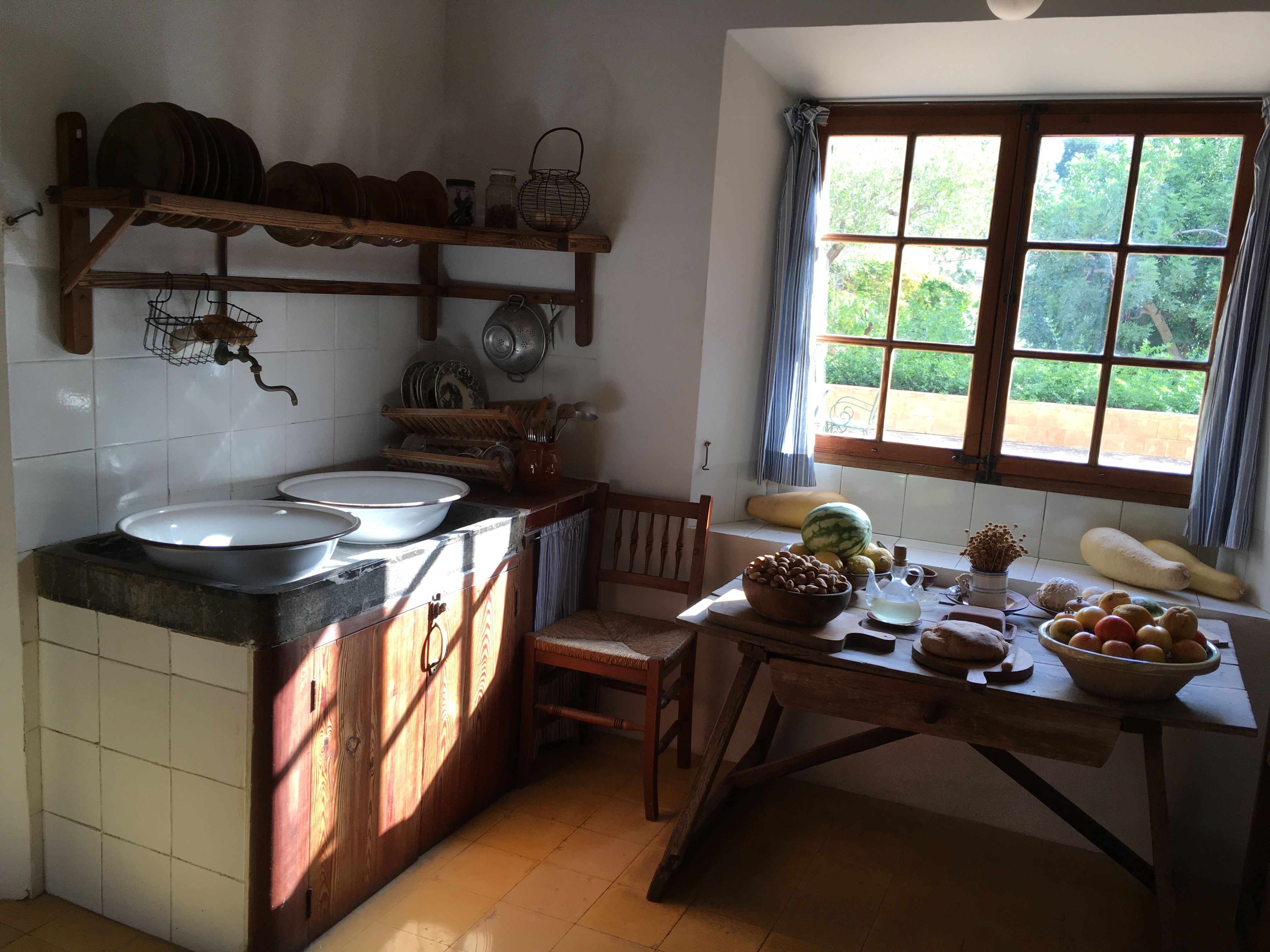
  • Let’s start at home. Using your scribble-chat technique, let your character invite you to where they live and show you, a room at a time, their kitchen, sofa, bathroom, garden/ view from the rooms, bedroom, bed and so on. Robert Graves’ kitchen in Mallorca is below – I loved that place.

IMG_1293

  • How does your character describe their bed. Tracey Emin was right, you’ll learn a lot.
  • Let’s move on to day to day travel – how does your character usually get around? Ask your character to describe their car, bike, route to work etc.
  • From there, it’s easy to lead the scribble-chat to your character’s work place. We spend vast chunks of our lives at work and have a wide range of feelings and reactions to it.

IMG_1186

  • What does your character do in spare time? Find out about their gym, choir room and so on.
  • Can you think of other places that are important to your character? Friends’ and relatives’ homes, for example. Worship spaces. Places to socialise.
  • Where is your character’s favourite place in all the world, real or imaginary?

2016-07-18 20.50.00

Different characters will see the same places differently of course and that’s always fun.

As usual, this is just exploration. You could have another go next week and find yourself up to the eyes in different answers. That’s great! You can choose what excites you most and works best for your characters and your story. Above all, you are immersing yourself more and more in your characters and their world, letting your writing flow, and getting closer to a deeply imagined, consistent draft.

On Sunday we move to Stage 4 – where is your plot’s engine? See you then!