Bright Scarf at the Poetry Cafe

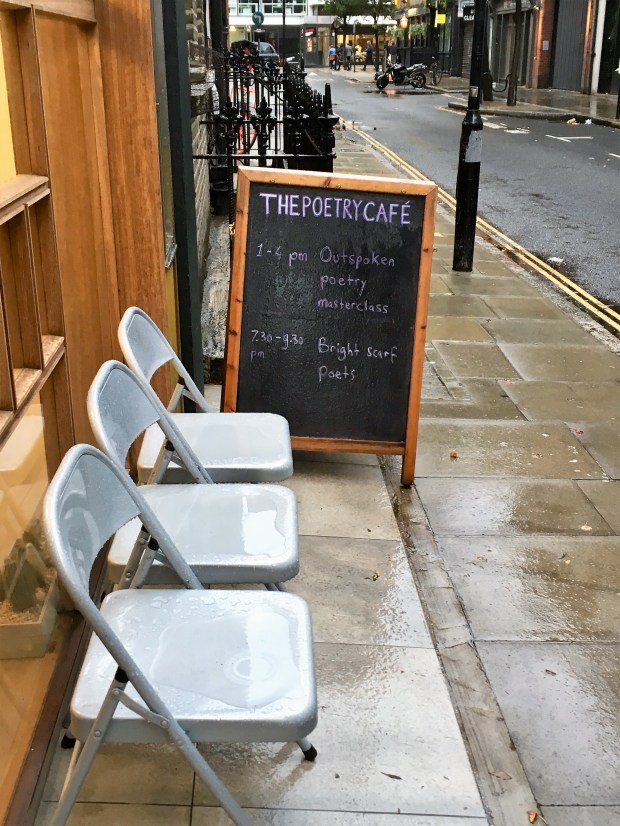
I risked taking my camera out in yesterday’s downpour to take a picture of our Bright Scarf name ‘in lights’ in Covent Garden, in case that was as good as it got. But people crowded into the Poetry Cafe’s event space downstairs in a wonderful mood with more chairs being found and drinks being bought in the refurbished Cafe bar. Poetry evenings are usually fun, especially for a poetry addict like me, but some events have a synergy which makes them more than usually exciting and this was one of them.IMG_E3719

Huge thanks to the fantastic audience who turned out, old friends and new, and to all the other Bright Scarf poets for their great readings: Dominic James, Colin Pink and Quentin Cowdry. Peter Pegnall, the founder and heart of Bright Scarf, is battling a chest infection and had to stay at home but special thanks to Colin for stepping in at the last minute. IMG_3726

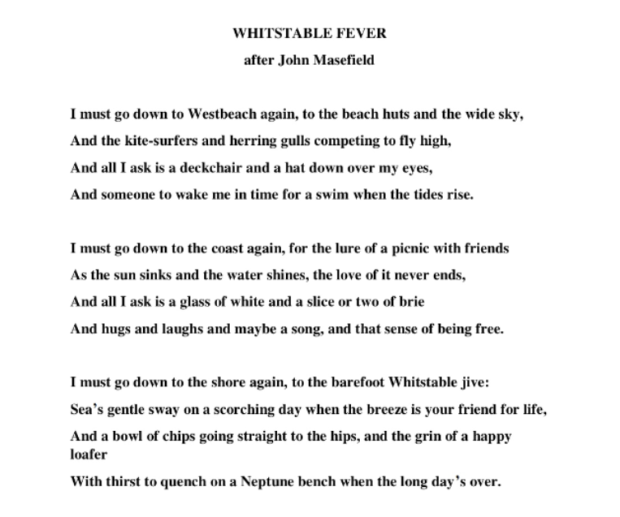
Thanks too to Irena Hill for organising the event so seamlessly and to all the Cafe staff in that great venue. With the wind and rain beating down outside, we felt as if we were sheltering on the high seas so here is my encore from last night, something to take us back to warmer days…IMG_2914

Hurray for independent book shops

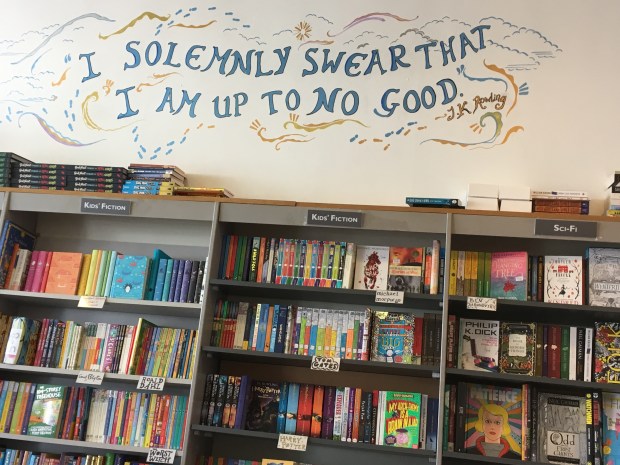
like Harbour Books in Whitable, one of my favourite places in all the world. It’s caught the attention of yesterday’s Observer newspaper here:

“We try to bring the community together with our events. We often host book launches and discussions with our wonderful local authors and they support us in turn. We also have a monthly poetry and prose night called Words on Waves,” says bookseller Olivia Rosenthal.

Congratulations to Keith and all his lovely staff – you do a wonderful job.

IMG_3404

An agent or publisher is interested – what happens next? #getpublished

Congratulations. An agent or publisher is showing enough interest to want to speak with you.

There is usually a slow process of meeting each other, to see if you will get along. The agent or publisher will shower your story with praise, then probably suggest changes to your script and see how you respond. Sometimes they are slight tweaks and can be fixed in a week or two. Other times, you can be asked to do substantial redrafts that take months. Throughout all this, they are looking to see how you handle the situation.

They want someone who responds quickly and takes advice well. If you let yourself be distracted by other pressures IMG_3442
or decide now is the time to close your laptop and take a gap year, IMG_3443you risk losing their attention.

Agents first

Do not expect a contract at an early stage although it can happen. Agents are more likely to be prompt about contracts than publishers and will send you a standard form of around a single page. In July we looked in detail at what agents do.

If a contract does come your way, keep breathing and think about it. You do not have to accept it straight away. You can ask for thinking time if there’s another agent/publisher you’re hoping to hear from. And it’s a good idea to consult the UK’s Society of Authors or a lawyer about the legal terms. There’s usually little you can renegotiate in standard provisions but it helps to be clear about what they mean.

As soon as the agent is happy with your script and has taken you on, your script goes out to chosen publishers. It came as a shock to me that agents get rejections too but it does happen. Maybe someone just pipped yours to the post or the heat has gone off a particular genre in the space of weeks. I have met an author whose agent was passionate about his thriller and spent five years hawking it around the world, but could not place it. There is a long history of classic novels being rejected many times. Rejection does not mean your agent is incompetent or that your novel is worthless. Stay calm, polite and positive – and keep writing the next thing.

The upside is that, at this level, you know your work will have been carefully read and that your agent will sift and report on feedback. If not, go elsewhere.

A publisher says yes

With undying thanks to your agent, you are sitting in the offices of a real, live, smiling publisher who has your work on the table. (In July, I posted detail about what publishers can do for us and when. My first post is here, and part 2 is here.) The publisher’s editor has put you through yet more rewrites and has satisfied the marketing and money people at the new acquisitions meeting that this deserves a chance. You’ve got a deal!

Congratulate yourself again – very few new writers reach this stage. Most publishers take at most one first-time novelist a year. A publication date is set and the cover’s agreed. You have more work to do now:

  • Your help will be vital with publicity and this starts before publication.
  • Prepare your own website if you have not already. Start blogging about your new book and how you came to write it. Podcasts go down well too.
  • It’s never too early to start your social media spinning.
  • Make friends with your local booksellers. They’re lovely and are usually delighted to meet local authors. Your publisher should provide you with some free publicity copies to hand out.
  • Contact local newspapers and blogs to ask for interviews and reviews.
  • Plan your book launch.
  • And try above all to keep writing the next thing. You’ll need it sooner than you think.

They’re asking you to buy some of your own books?

Your publisher will probably offer you the chance to buy some copies of your book yourself, at discount. The idea is that it encourages you to market it, hence all the ‘meet the author’ signing events. Events are tricky if you’re shy and they steal your writing time but the discount (paying 40% of the full price is not uncommon) means that if you sell at 80%, you are still making more profit, more quickly, than waiting for royalties.

Fame and fortune at last?

Most first novels sell fewer than a thousand copies. That’s why the Booker Prize was invented, to help literary novels reach a wider audience. Publishers and agents hope that by the time they publish your third or fourth, preferably in a series or the same genre, the public will have noticed you and the whole exercise will become financially worth their while. They are gamblers at heart. You may be one of the lucky ones who has a substantial advance from a big publisher who is going to flog your book with a great big publicity budget. I hope so. IMG_E1806Even if you’re not … You have become a strange new creature, a published author. That can lead you to other ways of making money (coaching, talks, radio and television appearances). It means too that people see you differently. Instead of the friend they are used to, the one who spends most of the time alone and gives a slightly dejected shrug when asked how the writing’s going, they see a new, confident you with a book in your hand. That book has your name printed on it and they are being asked to buy copies. After all the years of lonely scribbling, there is no finer sensation than welcoming friends to your book launch and watching them queue, smiling and laughing, for you to sign copies for them.

Congratulations, you’ve made it. It has all been worthwhile.

I wish you the very best of luck and happy writing!

Words on Waves at Harbour Books

Harbour Books is a fantastic independent book shop in Whitstable and it gave us writers space for something magical last night. Since July, the shop’s monthly Words on Waves events have given local writers a place to read their work in progress as well as published work, with a broad range of subject matter and styles of writing.

Last night it was mostly the poets’ turn and the air hummed with marvellous words from all over the world. An accidental common theme emerged about the roots of our upbringing and the considerable pleasures of living where we choose.

Mostly that was (of course) Kent. Our magnificent line-up included The Scatterlings (Sue Rose from Herne Bay, Mark Holihan, a Californian now settled in Broadstairs and Geraldine Paine from Ospringe, near Faversham), novelist Malcom Walton, prize-winning poet Christopher Hopkins (from Wales, now living in Kent), Annie Harrison, Clair Meyrick and, from London, Nancy Mattson (originally Canadian) and Mike Bartholomew-Biggs.

The combination was outstanding and, as host, I had the pleasure of watching waves of hilarity, excitement and shared grief sweep over us all. The evening was a sell-out so if you’d like to join us next month – Thursday 4 October – it would be wise to contact the shop to save your place. Please call 01227 264011 or drop by.

Enormous thanks to everyone at Harbour Books – Keith, Olivia, Arthur – for everything they do to make these events such a pleasure and success. It’s a privilege for me to be involved.

OYSTERS on the north Kent coast

by Rosie Johnston

Sapphires in a hurry-flutter:

two dozen starlings

rush to Sheppey.


Seaweed garlands roll on the high

tide, full

moon’s tangle of jet and jade.


The sea cradles me; my

best mother.

I roll and kick like a baby.


Ripples brush your naked shoulder,

a sibilance,

a sparrow’s whisper.


My skin, dulled under hospital lights,

exults

in blustery sunshine.


Twilight wraps blankets of

crimson glory

around this evening’s shoulders.


Sky is honeyed mango slivers,

dark rum-soaked,

with pomegranate seeds.


Laughter waltzes with garlic prawns,

jives with olives,

pirouettes with wine.


Between the bowls and candlelight

stretch moments

of perfect contentment.


Low tide takes its muted leave –

soft pools

marooned while oystercatchers play.


Whitstable, harbour of tangible

happiness:

peace glides into dock.


Where sea and sky merge in a

thousand pinks

aligns the mind’s horizon.


This fresh day. Let’s shuck it

open, feel

gusto pour between our fingers.


I read this in Harbour Books, Whitstable at our first Words on Waves event last month. It’s had such lovely feedback that it’s here for you to enjoy too.

We’re meeting again tonight at 6.45pm.

Happy writing!

The end is the beginning

Jessica Norrie's avatarWords and Fictions

In keeping with my new snappy style, I’m allowing myself 999 words max for this post. Most bloggers manage with much less; my problem is, I like wordy writers (Dickens, Balzac, Woolf) and my models have made me wordy myself. I’ve learnt that to write well in a spare elegant style, much as I admire it (Stoner, My name is Lucy Barton), you have to write better than I can. I bury infelicities in my forest of verbiage, but would be rumbled if every word stood out clear from the page. A writer with six hundred plus pages to fill can explore their own meaning aloud. It must be nailed first time in a novella.

28260537What I produce currently is somewhere in between. My beginnings are strongish and longish but not defined enough; they show just enough promise to keep readers on board. My middles are saggy, pushed…

View original post 754 more words

When the writing flow stops – 12 TIPS to keep writing

At our last Churchill Writers session, we started off talking about our perfect writing days, when the muse is our best friend and the writing flows like iced mojito down Papa Hemingway’s throat. Then, of course, chat turned to how we keep our writing going when things are not so good.

We came up with this list – feel free to add your own:

  • Keeping a journal can limber up the writing muscles and clear the mind before you start on your novel. Liz Lochhead has described it as like skimming the murky top off a broth before it’s served. I keep a writing journal too and save it for chats with myself about where my writing is going at the minute, what I want out of it and what’s getting into the way. It gives my inner writer the space she needs to be important again.
  • Congratulate yourself as much on good sessions of wool-gathering and writing exercises as on producing pages. It’s all needed.
  • A trick I learned from journalism is to get a rough draft down, quickly, last thing before sleep if need be, so that you have something to work on next time. Anything is better than nothing.
  • If you aim to write at a regular time each day or week, the writing begins to flow at that appointed time as if it has a special welcome.
  • Targets (1000 words per day, or a chapter a day, for example) work for some people, less so for others.
  • Going for long, leisurely walks alone, without (if you can) any thought of fitness or time, helps many writers. Charles Dickens walked huge distances, often through the night. It’s about letting your story and characters settle in the rhythm of your body while your eyes rest on the world around. Take some way of writing down stray thoughts, even if it means scribbling on the back of your hand. It’s not just about the desk. Beside Robert Graves’ beautiful writing room in Mallorca is this: IMG_1291
  • Writing buddies. Arrange to meet a writing friend in your favourite café for an hour or so. Say hello, and then sit a good distance away from each other for your writing time. When your words are done, it’s time to have a good old natter together. This can be a happy way to have a regular writing slot but it’s important not to let the chat happen first, OK? #learnedthehardway
  • Some days are fallow, don’t let them worry you. Just pick up again next time. In fact, life has tides, highs and lows, and it’s important not to punish yourself or get demoralised if writing is squeezed out by a crisis. Come back to it when you can.
  • If you don’t have the chance to write for a while, try writing in short bursts of ten or twenty minutes. Forget about quality, let the writing energy take you wherever it likes. You can do this on the bus, in a café, anywhere, and it will remind you how much you can achieve, and how deep you can go, in just ten minutes.
  • Reading good books and online links about the craft can bring you back into your sense of being a writer after a break away.
  • Remember that, however much you procrastinate, and we all do, once you do give writing your time and attention, the words will come. Every time I used to sit down to write, I would spring off the chair to do something else apparently urgent, maybe about a dozen times. Once I realised that my home was not going to catch fire if I just sat there and wrote, I dubbed it ‘hot chair syndrome’ and recognised that it was part of my run-up to writing. And it went away! I love writing and always feel better if a day has writing in it, and I bet you do too.
  • Keeping work in progress private is, for me, a crucial part of protecting the flow; having to show your workings every day to a well-meaning but critical family member can be death to your progress.

Keep it regular. Keep it to yourself. Keep it fun.

More on Sunday. In the meantime, happy scribbling!