Rosie Johnston’s previous book, Six-Count Jive was a study in domestic abuse and escape presented in sets of haiku-like poems. Her new publication, Safe Ground sets that experience, ‘a bad case of bad, bad husband’, in a wider context of trauma and recovery that reaches back to a troubled Belfast childhood, with a much-loved womanising, hill-climbing, opera lover father and a mother whose resentments ruined her relationship with her daughter, and forward to a happier present in poems that are baggier, more discursive, than those in the earlier book.
These personal troubles are set in a background of the Troubles, and at moments the public and private seem to overlap, as in this poem on the Abercorn bombing in 1972:
Over his shoulder we’d all seen it: the beast was out of its cage. Chill control, red-eyed in our homes, ready to clot our lives. The lowest we can be was loose. Nothing mattered now but blood.
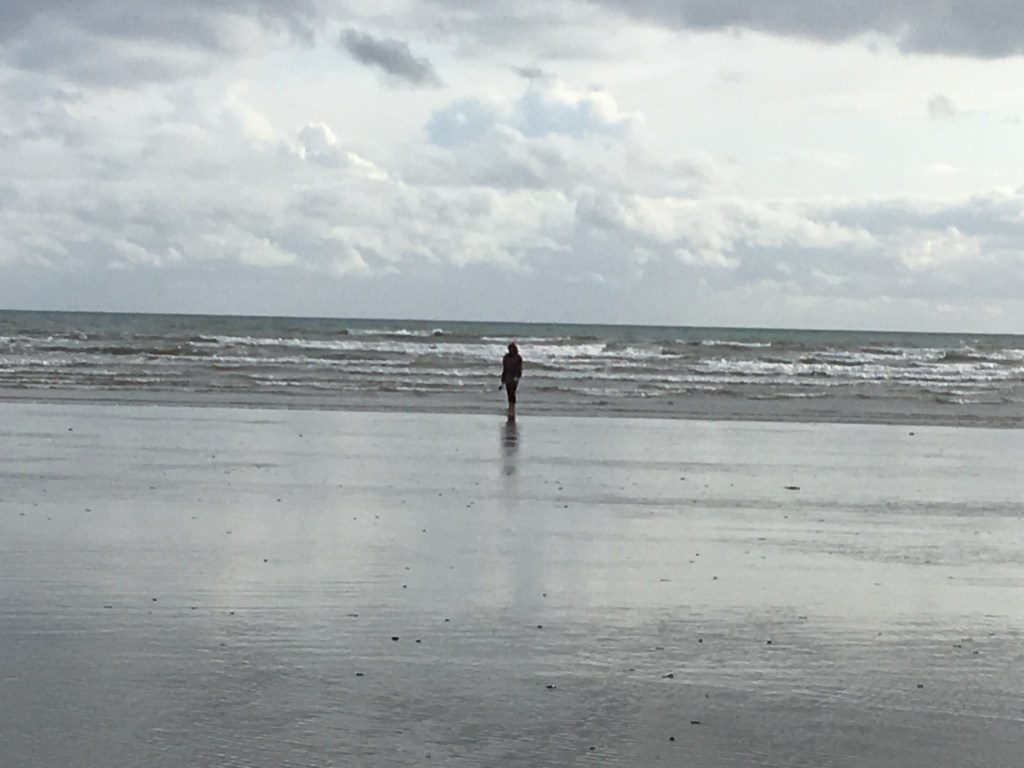
Her escape was, and remains, the sea, right from the very first poem here, ‘Carnlough Bay’:
I breathe. Expand again, at last, to my full size. I’m tallest in bare feet, on sea-rolled shingle, back heavy in my heels, cupping the weight of whelk shells in my pockets. Constant in it all, so many years, the need of sea.
We see the breakdown of that bad marriage and the speaker’s fraught relationships with her children, but in the end, in the final poem in the book, there is a sense of wholeness, the Waste Land redeemed, its curse lifted by (and by) the sea:
We run, crabs loose from a spilt green bucket, back to the best of childhood.
Content with plastic spades, we burrow where our simplest selves can find us.
On Margate Sands songs and laughter ride the winds, connect us all with all.
That ‘loose’ brings us back to the Abercorn poem, but the worst we can be is transmogrified into the simple best in an echo of marvellous deftness.
And it’s not quite the end, as that final poem is followed by a four-and-a-bit page prose piece, ‘Laughing and Grief: Paris, 2020’ (recalling the Mock Turtle’s tale in Alice in Wonderland) telling the story of a visit to Beckett’s grave, or at least a failed attempt to find it that was salvaged by a kindly 80-year-old Parisian gentleman, Henri, who brings her to Sam’s grave, and then that of Jean Seberg, where he shows the narrator a card he wrote and placed there earlier. The story brings us back to her father, via Horace, a shared enthusiasm, and we get to see their final interaction before his death. And the card? It read Jamais de désespoir (Horace’s nil desperandum) translated by Johnston as ‘Never lose hope’, fitting words for the book to end on.
This very well-written story (definitely not a prose poem) leaves me wondering what next for Rosie Johnston? After two fine collections navigating trauma, is she now moving away from that subject and on to a post-recovery mode in which the bright world of Margate Sands is her theme? I’m eager to see.
My latest poetry review is here on the marvellous London Grip website. If slush and drizzle are keeping you snug indoors, London Grip is your perfect companion. Every kind of culture is there.

 Rosie Johnston