The Lake magazine: ‘This is a superbly crafted piece of work whose language is at times sublime.‘
Billy Mills on his Elliptical Movements said ‘This is an important little book. Read it.’
London Grip magazine: ‘Six-Count Jive is a brave and honest book, one which I hope will not only be enjoyed as poetry, but also give encouragement to women recovering from similar experiences. Rosie Johnston dedicates it to everyone with PTSD, “especially those of us traumatised in our own homes.’
London Grip: ‘I highly recommend Safe Ground as it intelligently and powerfully communicates both the pain and joy of a complex life, lived by a cultured woman who has resolved ‘Like father, like daughter, I would live my life to the full and embrace love.’’
High Window: ‘At the end of the day perhaps the only ‘safe ground’ in an age of trauma is the refuge of being able to write about it. There is tenderness, trauma and wisdom in these pages:
Veiled dreams. That need to please, appease, make good, make safe. Make it out of there. (“Reflection“)’
SIX-COUNT JIVE (Lapwing Publications, 2019), original cover. Dennis Greig and his wife Rene were keen ballroom dancers; Dennis’s design shows how trauma can scatter the brain.
The memoir called Inside Out is by another Rosie Johnston, by the way. Nothing to do with me.
Sian Thomas describes her POETRY BATH radio show as ‘a place where poetry lovers can immerse themselves in words and word play. In each episode Sian meets a writer to listen to their work and explore the joys and challenges of the writing life.’
Sian’s programmes are an utter delight and I’m thrilled and grateful she has found time to interview me, in celebration of my fifth book of poetrySafe Ground, published by Mica Press this spring. Her interview falls into two parts, each around half an hour:
What she doesn’t say out loud is that she is not only a fine poet herself, but an expert interviewer, searching more deeply than most – always kindly – among the nooks and crannies of our lives and writing processes. A ramble through her other interviews will be well worth your time.
And it’s always great fun being with Sian. Our chat swirls from her learning the Welsh language and my taking up Irish mandolin, to poetry (hers, mine and everybody’s) and when we’ll go and wash the past away in a paddle together in the North Sea, just ten minutes from where I live.
Jennifer Johnson is known for her meticulous reviews and I love the way she draws sections of the book together, building to this enthusiastic encomium at the finish:
“I highly recommend Safe Ground as it intelligently and powerfully communicates both the pain and joy of a complex life, lived by a cultured woman who has resolved ‘Like father, like daughter, I would live my life to the full and embrace love.’”
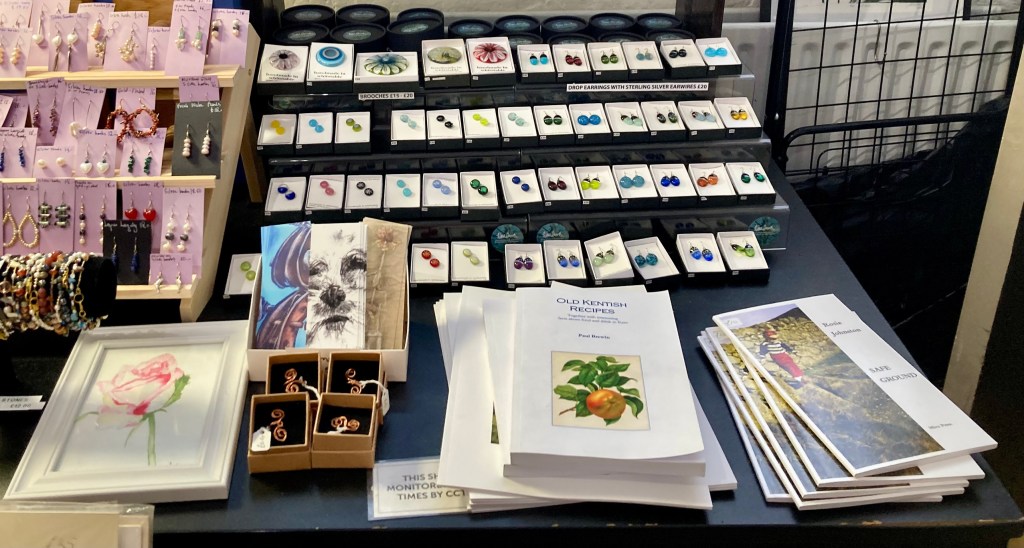
My latest book ‘Safe Ground’ is getting a wonderful reception. Many thanks to everyone who’s contacted me to say what made you laugh and moved you. Where can you find the book for yourself, or for your friends?
Rosie Johnston’s previous book, Six-Count Jive was a study in domestic abuse and escape presented in sets of haiku-like poems. Her new publication, Safe Ground sets that experience, ‘a bad case of bad, bad husband’, in a wider context of trauma and recovery that reaches back to a troubled Belfast childhood, with a much-loved womanising, hill-climbing, opera lover father and a mother whose resentments ruined her relationship with her daughter, and forward to a happier present in poems that are baggier, more discursive, than those in the earlier book.
These personal troubles are set in a background of the Troubles, and at moments the public and private seem to overlap, as in this poem on the Abercorn bombing in 1972:
Over his shoulder we’d all seen it: the beast was out of its cage. Chill control, red-eyed in our homes, ready to clot our lives. The lowest we can be was loose. Nothing mattered now but blood.
Her escape was, and remains, the sea, right from the very first poem here, ‘Carnlough Bay’:
I breathe. Expand again, at last, to my full size. I’m tallest in bare feet, on sea-rolled shingle, back heavy in my heels, cupping the weight of whelk shells in my pockets. Constant in it all, so many years, the need of sea.
We see the breakdown of that bad marriage and the speaker’s fraught relationships with her children, but in the end, in the final poem in the book, there is a sense of wholeness, the Waste Land redeemed, its curse lifted by (and by) the sea:
We run, crabs loose from a spilt green bucket, back to the best of childhood.
Content with plastic spades, we burrow where our simplest selves can find us.
On Margate Sands songs and laughter ride the winds, connect us all with all.
That ‘loose’ brings us back to the Abercorn poem, but the worst we can be is transmogrified into the simple best in an echo of marvellous deftness.
And it’s not quite the end, as that final poem is followed by a four-and-a-bit page prose piece, ‘Laughing and Grief: Paris, 2020’ (recalling the Mock Turtle’s tale in Alice in Wonderland) telling the story of a visit to Beckett’s grave, or at least a failed attempt to find it that was salvaged by a kindly 80-year-old Parisian gentleman, Henri, who brings her to Sam’s grave, and then that of Jean Seberg, where he shows the narrator a card he wrote and placed there earlier. The story brings us back to her father, via Horace, a shared enthusiasm, and we get to see their final interaction before his death. And the card? It read Jamais de désespoir (Horace’s nil desperandum) translated by Johnston as ‘Never lose hope’, fitting words for the book to end on.
This very well-written story (definitely not a prose poem) leaves me wondering what next for Rosie Johnston? After two fine collections navigating trauma, is she now moving away from that subject and on to a post-recovery mode in which the bright world of Margate Sands is her theme? I’m eager to see.
You can never tell when you’re writing something whether it’s going to have impact or not. I never foresaw that so many people would bother to thank me for this one, even walking down the street after me in Broadstairs last summer. The poem I’m reading here is ‘Being with Anne’ (‘Safe Ground’, Mica Press, 2025), for my beloved Auntie Anne. My mother was senior in a long family so Anne, her youngest sister, isn’t that much older than me. I have so much to thank her for.
Last weekend I was being blown over with my sons at the top of Arthur’s Seat in Edinburgh – many thanks to the kind stranger who caught me and helped me to my feet before I crashed sideways into a boulder! Today it’s Amazon’s French Poetry list that has me blown away – ‘Safe Ground’ is at number 4, between Billy Connolly and ‘The Count of Monte Cristo’.
How on earth is a wee book of poetry written in English on that list at all? My book ‘Safe Ground’ tells the story (in poetry) of my travels and escapes from Northern Ireland via Cambridge and London to the north coast of Kent. Where does France come in?
In February 2021 my home was full of builders making emergency repairs to the roof. In icy blasts, they clambered like mountain goats among the scaffolding. It felt at the time as if we might never get to socialise in public again, so escapism took hold. I wrote about a little trip I’d made alone to Paris the previous February and relived the pleasures of sitting in a Parisian restaurant. Those scribbles became ‘Laughing and Grief’ (as the Mock Turtle used to say), and were published later that year by American Writers Review in their 2021 Turmoil and Recovery anthology.
With thanks to lovely Henri who helped me climb through the graves in Montmartre cemetery to find Beckett and Seberg, ‘Laughing and Grief’ is about how laughs and sadness jostle together in our lives and how recovery can find us at the strangest times. You can buy here from Amazon or here from publisher Mica Press.
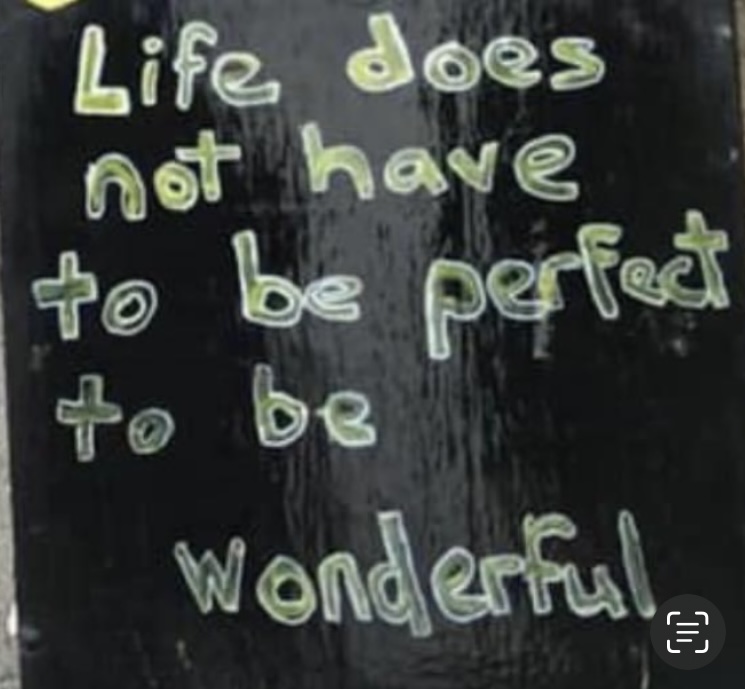
Thanks to No Alibis in Belfast who had this sign outside their excellent book shop years ago and I couldn’t resist a screenshot.
It’s Safe Ground‘s big day! You can find it on Mica Press’s website here and on Amazon. No reviews yet but the initial responses are huge smiles and enthusiasm.
If you’d like to buy one from me direct, signed specially for you, please don’t hesitate to contact me at rosiejohnstonwrites@gmail.com
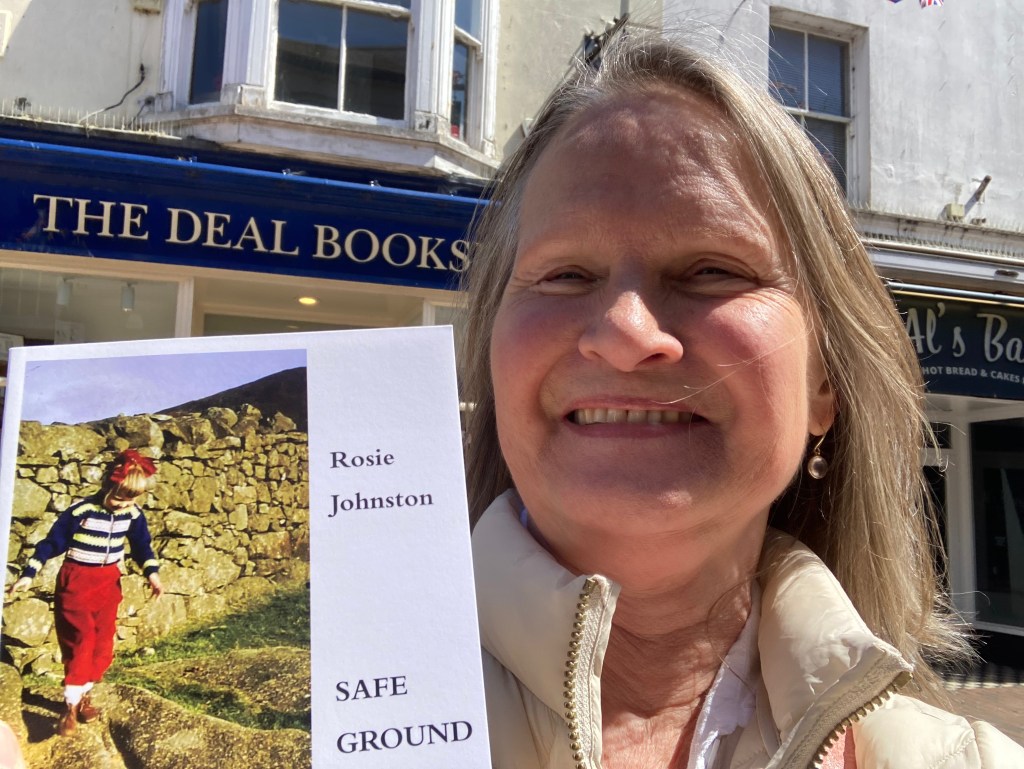
The cover photograph is me beside the Mourne Wall in County Down, taken by my father more years ago than I care to count. As I said in my dedication to Bittersweet Seventeens (Lapwing Publications, 2014), he gave me life in so many ways.
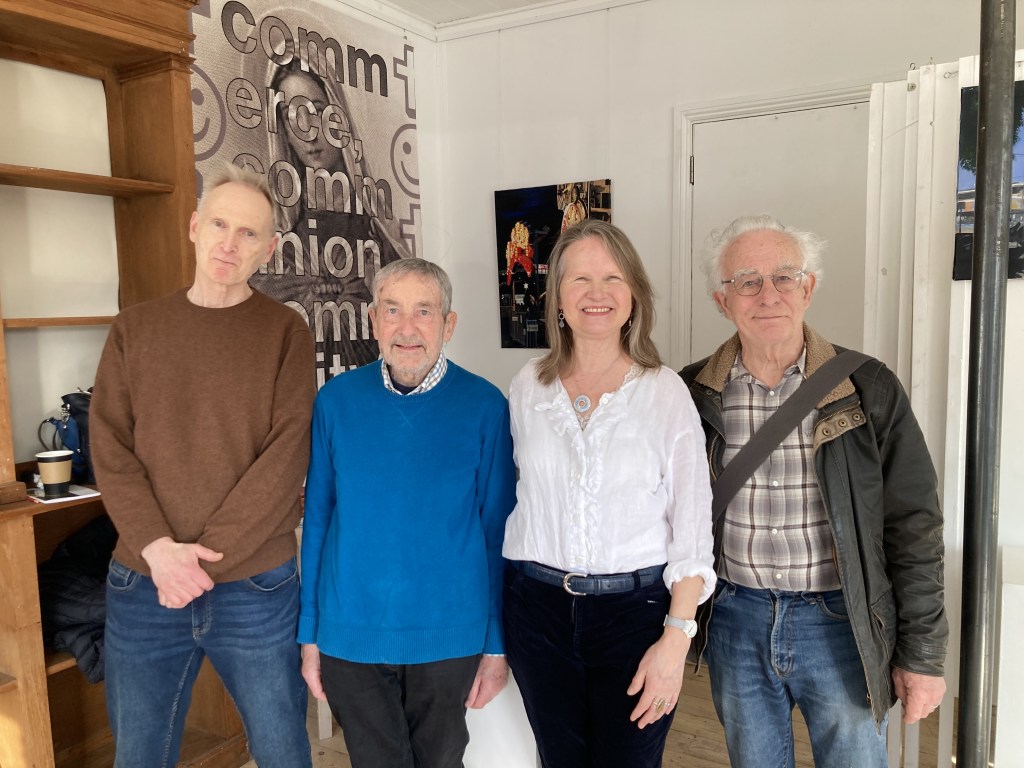
Wivenhoe in Essex was all sunshine and spreading buds yesterday and people who could hardly believe that it really was early spring. Leslie Bell of Mica Press met AC Bevan and me off the London train and we walked along the riverside with almost forgotten warmth on our backs. We were heading for the Old Grocery, a beautiful little gallery in the town centre where AC and I would read from our new collections with Antony Johae, all of us Mica poets. The audience were wonderful – laughter and a few tears of course, excellent questions and lovely company. I’ll remember this event as one of the warmest I’ve experienced. Very many thanks to Les Bell, AC and Antony, and to Della and Jonathan of the gallery.
Safe Ground traces my search for safety from the Causeway Coast and Troubles Belfast to peace and a sense of home near Margate Sands where TS Eliot wrote part of The Waste Land. The shore is a significant healer in the poems and North Sea winds gust through them. I will be enormously proud to be a Mica poet, and hope you can come to celebrate with us and enjoy the depth and scale of Mica’s work. Here I am by the Mourne Wall a long time ago…






 Rosie Johnston